I went to prison, here is that experience: Part I

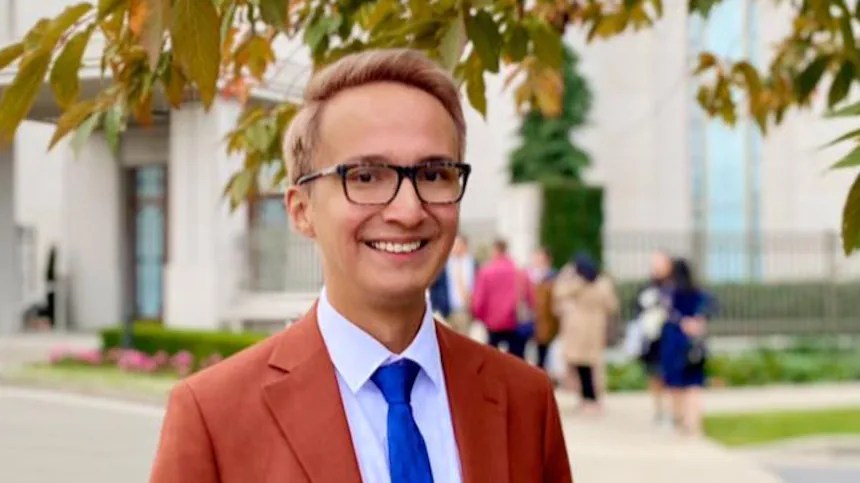
In October 2024 I was sentenced on one count of sexual interference in provincial court. There is no hiding this fact, CBC News, my former employer, updated their own article on me to reflect as much.
I want to tell you about everything that happened since then, and everything I saw inside “the system.” You might be wondering why you are reading this, or why you care, but as a former journalist I believe in reporting on facts. This is a story of injustice, and government bureaucracy, and friendship, and love. It’s a bit lengthy, so if you’re willing to get into it, let’s get into it.
The sentencing
There were no cameras, there wasn’t a media circus, all of which was surprising considering all the coverage the initial charges received. Perhaps crime stories are more sensational if there is the potential for a lengthy court battle than if a person submits themselves willingly to the justice system, to be held accountable.
I turned myself into the police, and was then granted bail. I was cooperative with the VPD investigation, and agreed to a joint-submission with Crown counsel. I believe strongly in accountability, and justice, and that in doing wrong, I needed to be held accountable.
- I went to prison — here is that experience: Part Four
- I went to prison — here is that experience: Part Three
- I went to prison — here is that experience: Part Two
- I went to prison — here is that experience: Part One
The judge sentenced me to two years, less a day. This is a provincial sentence, in legal terms, meaning I was not going to a federal institution. On the judge’s recommendation I was to be sent to Ford Mountain Correctional Center, which is where this story really begins. First, like Dante needed to travel through many levels of hell, I needed to be processed.
The Vancouver Courthouse, North Fraser Pre-Trial, and Fraser
There is a book called Marie Antoinette: The Journey, by Antonia Fraser, in which she describes the experience Marie Antoinette had in arriving to France for the first time. She was ceremoniously stripped of her Austrian clothes and given French ones. Reading this fact reminded me that the State is symbolic in everything it does. Fascinatingly enough, Fraser describes the prolonged fall of the monarchy through the stripping away of this power. Over the course of her years-long imprisonment, Marie Antoinette was slowly stripped of all her nice things, until all that she had left were prisoner clothes, too.
The judge handed down her sentence and the room fell silent, and I was awkwardly brought to a Sheriff who formally put me into custody. I was asked to remove my Canadian flag pin on the lapel of my black suit, and my tie, and led down a series of corridors and stairs into the basement holding cells of the Vancouver Courthouse, adjoining to the Vancouver Police Station. I awaited further processing there, and slowly was stripped away of my own sovereignty.
Finally, I was placed in a larger holding cell with two other gentlemen who were… not exactly the suit-and-tie variety I tended to associate with. My lawyer had warned me the week before that I was “going to meet a lot of different types of people, and they won’t all be like you.” These gentlemen needed a shower, and were messy in appearance, and the one was definitely not afraid to let the guards know on multiple occasions that he wanted his “bagged lunch.” I also learned my first lesson about prison culture, and perhaps one of the most recurring ones: people in prison only seem to ever talk about being in prison, why they’re in prison, why you’re in prison, and other prisoners. It’s like they didn’t have personal lives or backgrounds or existences prior to this chapter in their lives.
We were transported in a van equipped with holding cells through the rainy streets of Vancouver, Burnaby, and Coquitlam. On October 17, 2024, there happened to be torrential rainfall which caused tremendous flooding in Coquitlam. We were dropped off at the North Fraser Pre-Trial Center, which is where I would spend the next week of my life. There, I was given a red shirt, a red sweater, red pants, and white shoes. I traded in my white dress shirt and Oscar de la Renta tie, and my sparkly shoes for an outfit I’d never have worn on the outside.
This is your typical panopticon, it has three levels of cells all facing the desk where the BC Corrections staff monitor the entire unit. The inmates are institutionalized, meaning they develop a personality and way of functioning that is entirely dependent on the system they find themselves at the mercy of. Everything is highly scheduled, and regimented in a correctional facility, and many people react a certain way to having their freedoms and liberties taken away. They tend to fight harder to control the little that they still can control, and this manifests through petty squabbles and artificial hierarchies. I tried to avoid people that week, and instead read alone in my cell. I was not interested in making friends with any of these people.
Eventually, I was taken away and transported to Fraser Regional Correctional Center, which is supposedly the main hub for the lower mainland. I spent three days there before finally being sent to my destination, and what was to be my home for the foreseeable future.
Ford Mountain
If you Google Ford Mountain, you will likely come across a blog from another former inmate, and he does a lovely job of describing it there. This is not to upstage that individual’s account, but it’s written in the 90s I presume, and a lot has changed since then.
If you drive along Highway 1 past Abbotsford, and getting up to Chilliwack, you reach a stretch of road where the plain gives way to a breathtaking view of the mountains. There is a valley in those mountains that keeps going just as the highway turns north towards Hope. Down that valley, about a half an hour through there, is Ford Mountain Correctional Center.
I was transported there during the day, it was a Wednesday, I believe. I was sitting in the transport vehicle with two other men, each in their own holding cell. The one man was short, white, with brown hair and vibrant blue eyes. He resembled a feral cat, to me, those eyes would come to haunt me over the next year, but I did not know it then. We travelled for what felt like hours, but was perhaps only one hour. Finally, we arrived at Ford Mountain, and turned off the road just before Chilliwack Lake onto a long driveway that ended in a parking lot.
The entire perimeter was surrounded by two fences, an outer fence and an inner fence. We could see several buildings scattered across the compound. The BC Corrections transport vehicle pulled up to a two-layered gate and once we got inside the innermost fence we could see it all a lot clearer. Ahead of us was the central administration building, to the left were a few other buildings, and to the right we could see four long, blue huts. These were the main living quarters for the inmates.
The RLC Cult
The staff processed us fairly quickly, and we were introduced to two other inmates right away. The staff referred to them as “residents,” which was my first clue. However, staff at Ford Mountain only ever referred to us by our last names. The two gentlemen we were introduced to were resident Adams and resident Samuels (names are changed, of course).
The man I was curious about in the transport vehicle introduced himself as Jessie Jacobs, and he was quite talkative now. He chatted away incessantly about his long trip from the Island, and the stopover at Fraser, which is where I had been retrieved from. He talked about anything and everything, which was the first thing I learned about Jessie Jacobs.
Adams and Samuels led the three of us to the dining hall, which was adjoined to the admin building. It was now 4:15 pm, which according to the daily schedule at Ford Mountain, was dinner time. There were approximately 40 residents seated along four rows of tables, all chatting away loudly. We picked up our dining trays and proceeded along the cafeteria-style food servicing station. Residents dressed in the same uniforms we had on, except in white, served us dinner. We took our food on our trays and sat down.
Adams and Samuels introduced themselves as RLC “counselors,” and explained that RLC stood for Right Living Community. According to BC Corrections:
“Another alternative placement option is Right Living Units, which bring a positive, ‘pro-social’ approach to a living unit for individuals who show they are committed to changing their lives. Right Living is a safe and healing environment that prepares residents to maintain a healthy life when they return home.
To reside on a Right Living Unit, individuals make a commitment to the Right Living philosophy and must follow the community rules, which include no violence, no weapons, and no use of non-prescribed substances.”
This is, of course, only the public-facing explanation of the RLC. Through later investigation, I found out that RLC units exist in multiple correctional facilities across the province. After speaking to several residents during my time at Ford Mountain, and staff members, I gathered that RLC units were somewhat more privileged than regular units were. The main difference is that Ford Mountain is an entire RLC community, whereas other centers only have an RLC unit.
For your benefit, the RLC philosophy goes: “We have come to a place to heal ourselves from behaviours, thoughts, and moods that interrupted our daily living. We choose to rebuild the potential of our lives. We will practice respect in attitudes and behaviours to reconnect with family and community.”
It was a mantra that I would be required to chant every Monday morning and Friday afternoon for the next 16 months of my life. The RLC meeting was held twice a week in the gymnasium, and although it appears to be an innocuous saying, I would also later come to think of it as a brainwashing mechanism.
Adams and Samuels led us into the library after dinner, which was located in a separate structure. Books lined all the walls, and there were several tables in the room. At the back was a TV monitor and a video game console. There were board games and card games as well.
There, Adams and Samuels gave us the official orientation. We were assigned huts to live in, and I was a bit disappointed to not be living with Jessie, who I felt I’d bonded with. We were told that we would be assigned to work on grounds to start, which involved raking pine needles that fell all year round, or perhaps gardening. From there, we could apply to work in any of the other jobs offered to inmates at Ford Mountain.
“Forestry” was the big attraction for many residents, as it offered the most pay. BC Corrections has a contract with BC Wildfire and in the upper compound at Ford Mountain, residents working in Forestry test and repair hoses used by BC Wildfire. There was also an implicit understanding that the men who worked in forestry were stronger and perhaps more desirable than the others. Having heard the speel, it sounded like exploitation to me. I would be expected to work longer hours, a lot harder, for nominally higher pay (a difference of $20 per week at the higher end).
I was interested solely in one thing at Ford Mountain, and that was access to education. I didn’t have the best marks in math, and knowing that I probably wouldn’t be able to work in journalism anymore, I figured I needed to pivot careers long before being incarcerated. So, in the year that I had been out on bail I was upgrading with the goal of going back to post-secondary for something else. This required upgrading math, and since I was now incarcerated, I figured I would take advantage of the time and free education opportunity.
After Adams and Samuels gave us the tour, Adams led Jessie back to their hut. Each hut was named A, B, C, and D (BC Corrections staff use the NATO phonetic Alphabet, so for them, it was Alpha, Bravo, Charlie, Delta). Jessie and Adams were in Bravo, and I was placed in Delta. I came to find out that everyone in Delta worked in Forestry. I felt a little bit like Harry Potter must have felt when he urged the sorting hat to not put him in Slytherin, except that’s where I’d been placed.
One of the other residents sought me out within the following days, and introduced himself as Kevin Lahey, a peer support. He said he would be there to listen to me if I ever needed it, and disclosed that he made $1 for every session we had. I respected it, he was transparent at least. Later on I would come to find out he was a Christian, and we would have many discussions because of this (I am a member of the Church of Jesus Christ of Latter-day Saints, myself). He also worked in the film and television industry, previously, which is what I found most interesting about him. It was nice to find somebody a little bit like me in this place. Kevin also worked in the kitchen, and I recalled seeing him my first day there. He was always smiling, for some reason, despite us being in literal prison.
Another individual I met right away was the Chaplain, who introduced himself as Mark Michaels. He was a former chaplain in the federal system, and before that he worked for the Department of Defence. He had a degree in theology, and was currently studying the radicalization of inmates in the criminal justice system. Surprisingly, he too was also quite cheerful all the time. He invited me to an activity he hosted in Holloway House (a traditional prison-style building on the premises which was currently unused, save for one common area, which we simply called “Holloway House”). He called the activity “Chaplain’s Trivia,” and asked me to come. He was recently hired at Ford Mountain and was desperately recruiting residents to his Friday night trivia.
I spent the night setting up my room, after obtaining several changes of red clothes from the laundry room. I enjoy warm, ambient lighting, so it needed to be perfect. I immediately found myself in the library in the classics section, and the history section, taking out Plato and Thucydides, and textbooks on the history of Constantinople. I lined my desk in my room with these books, some of which I had in my own personal collection back at home. I turned on the TV and found myself watching CBC Vancouver.
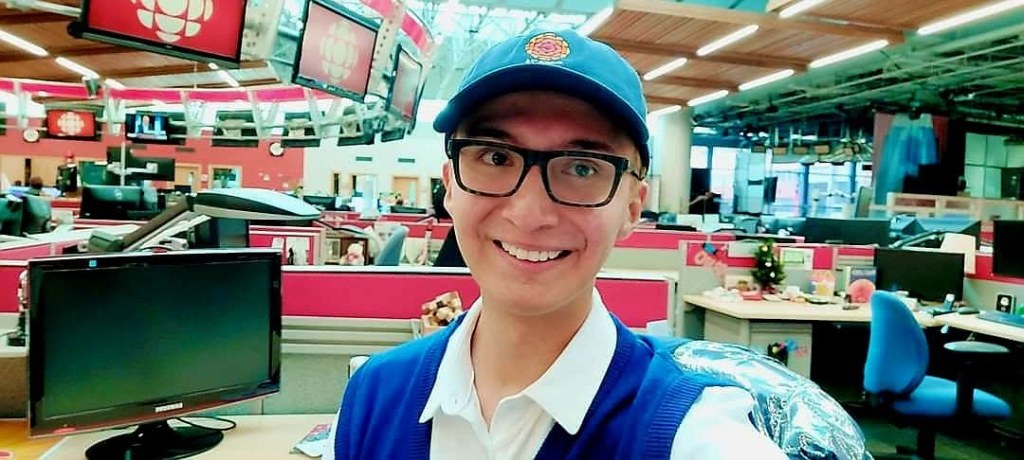
Here I am in 2022, back when I first started working at CBC. Photo credit: Vincent Papequash
It was surreal, I was certain that I was the only inmate here, and perhaps throughout all of the BC Corrections system, who could easily watch his former workplace on television. I could pick out the desk I used to sit at, in the background. I imagined what it must have been like for some prior resident to be casually tuned in back in 2023, and to see a blurry image of me sauntering around the background like I now saw on my television in the room I found myself in. I knew the people on the screen, I used to work with them. In the year I’d been out on bail, I tended to avoid watching the news altogether, much less tuning into the channel I used to work for.
When I awoke the next morning I had to be at the dining hall by 7:10 am. Eating breakfast was not mandatory, but showing up to be counted by staff was. Then we had a morning meeting inside our hut with just our fellow hut residents. Each week had a theme, some of which included: Change, Changing Your Behaviour, Attitude and Respect, etc. I don’t recall the specific theme of that week, but every day we were posed a question and each resident in the hut had an opportunity to answer it. The meeting was conducted by the “Hut Rep,” who was democratically elected. However, RLC counselors were unelected, and had more influence over “camp” activities and proceedings. These individuals were hired by the RLC coordinator, a BC Corrections staff member.
Following this meeting we had a mandatory roll call in the parade square (a parking lot in front of the admin building). This was at 8:30 am. It was here that I finally realized the beauty of my surroundings. In front of us and behind us towered Cascade mountains which lined the entire valley back to Chilliwack. On the other two sides of us, to our left and right stood two smaller mountains. One of these is apparently called Ford Mountain, which the facility got its name from. Technically speaking, it’s since been renamed to Xàws Schó:lha, in line with the current provincial government’s mandate to make nominal changes for Indigenous peoples without actually doing anything substantial for them.
Jessie Jacobs and I were assigned to work on grounds together after roll call, where everyone split off to their assigned duties. It was during our work day that I learned a little more about him. I will not disclose his charges, but he was adamant about telling me and anyone who would listen all about it. Jessie would develop a reputation amongst the residents for being too open with his charges, it offended a lot of people to hear him talk to brazenly about it. I also learned how warped he truly was, and how he saw the world. He didn’t believe he had done any wrong, and he wasn’t ashamed to let other people know it.
Despite his flaws, I wanted to be his friend. Over the following days, I realized I was attracted to him. It was then that I relearned the first lesson about prison: people in prison only seem to ever talk about being in prison, why they’re in prison, why you’re in prison, and other prisoners. I heard other people talk about him behind his back, he would not stop talking about other people behind their backs, and during a card game I’d been invited to with two other inmates I’d befriended, Jessie was the main topic. Everyone seemed to be obsessed with Jessie Jacobs.
This concludes Part I of this narrative.
All names of inmates and staff have been changed for privacy reasons. Names of organizations and public figures are unchanged. Although presented as a narrative, this is my account of true events. As a former journalist, I wanted to write about my experience after being incarcerated.
 Vincent Papequash