I went to prison, here is that experience: Part II

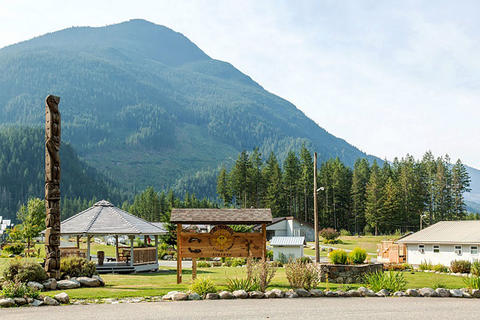
Ford Mountain Correctional Center, located in southern British Columbia. Photo courtesy of Claire Garner Photography/BC Mental Health
By November 2024 I was settling into my new home at Ford Mountain. Back when I was working at CBC, I lived a very hectic and metropolitan lifestyle. It was always about business meetings, and politicians, and church activities. I was stressed out and constantly busy over absolutely nothing. I often dreamed of running away and joining a cult, like rich, educated people did in the 90s.
How this all started
Back in 2019 I found myself volunteering for a Conservative candidate. When he lost the election we went out for coffee and spent three hours talking. He was fascinated to know how I balanced being a Mormon with being gay, and how I could be a journalist and a Conservative. I towed many lines, I figured.
I told him about my crazy obsession with joining a cult, and he was super excited to show me a Netflix series he’d watched. It was called Wild, Wild Country (2018). It was about an Indian guru who moved his cult to America, namely to a rural town in Idaho. Everyone wore red and had tantric sex, and the whole brains behind the operation was a lady named Ma Anand Sheila. She rigged a town election and installed her cult followers in the council so she could have absolute power over bylaws and zoning, to further develop the compound. She ended up going to prison for committing atrocious crimes, allegedly, including poisoning the town’s water supply when several residents complained.
- I went to prison — here is that experience: Part Four
- I went to prison — here is that experience: Part Three
- I went to prison — here is that experience: Part Two
- I went to prison — here is that experience: Part One
I ended up deciding after this friend took a job in Ottawa working for the party in a different capacity that I wanted to go to Ottawa as well. However, I did not account for the fact that I was about to undergo some of the most difficult years of my life, as far as my mental health was concerned.
I began to spiral into alcoholism, and if you know anything about Mormonism, you might know we are not allowed to consume it. That did not stop me, I figured I could sin now and pay later. I hid my alcoholism from everyone at the church, and all my metro-chic acting friends I was making partook in regular partying anyhow, so it didn’t really matter. I was living a double life.
Rewind to many, many years ago, when I was living in Edmonton, AB. I met somebody quite randomly, a young gentleman, who was perhaps only a few years older than me. I vividly recall having an intense debate with him over political ideology, more specifically over Conservative ideology. It made such an impression in my mind, that when I continued to encounter him I often remembered our debates. He went on to become a member of parliament, and he will remain unnamed here.
Going back to 2020, I took a job working in Prince George, BC, for CKPG News. Shortly after, I quit because I wanted to move to Vancouver to pursue an acting career. Instead, I met a guy and entered into a relationship, and just around that time I got a job interview for CBC Edmonton. Over a night of many alcoholic beverages with my new boyfriend, I confessed to wanting to take the job because it might finally give me an opportunity to interview this MP I’d had feelings for.
I forgot about it the next day, and moved on with my life, and I didn’t get the job at CBC Edmonton. Over the summer things ended with that particular boyfriend, probably for the best, as I wasn’t in love with him. So, I moved to Vancouver, BC and began my acting career in the fall of 2021. Then I got into an online debate with the MP in question again and this rattled me for a few days, before I put it away from my mind one more time.
I spent the next year as a background actor in a few major productions in the Lower Mainland before I landed a job at CBC Vancouver in October 2022. One day I was across the street at the library, taking out books and I stumbled across something about the Dreyfus Affair. The member of parliament in question mentioned the book to me during our argument, as an analogy for how he felt. I figured I’d read the book so I could find some sort of flaw in an argument that was already a year old, so that next time we spoke I could bring it up.
That’s when I began spiralling, and I started wondering if I was in love with him. So, I asked for a secondment to Ottawa only a couple of months into my new job, and CBC granted it. My plan was to go there and confess my feelings to the member of parliament in question. When I got there, finally, I ended up not doing that. I realized how absurd I was being, and got cold feet, and returned to BC a couple months later.
Combined with the alcoholism, and the mental health issues I was having, I was on a collision course for disaster. I was experiencing loneliness and isolation, because instead of talking to friends about my problems I was hiding my alcoholism out of fear of rejection from my community. Instead of seeking professional help I figured it was simply work stress. During a night of excessive drinking I suffered a delusional episode and committed the crime that landed me here.
I turned myself into police right away, and felt tremendous guilt. I never had any intention of denying the charges, or fighting it in court, or turning this into a much bigger problem. I truly believed that I made a terrible mistake in causing the harm that I did, and I needed to face the consequences.
Life at Ford Mountain
I spent long days in the rain raking pine needles off the ground. It actually helped if it was raining because they stuck together better. Jessie Jacobs and I became close friends. I told him my life story, and he told me his. He was from Nova Scotia, and was at Ford Mountain on remand, which I found exceptional. Remand is where a person is in custody awaiting sentencing, as opposed to being out on bail.
Jessie told me he was bisexual, and I tried to be subtle about figuring out if he was interested in me. That was very hard to do because everyone in “camp” knew everything about everyone else. I told some new friends while playing a card game with them that I was interested in Jessie with the specific intention that they would tell him for me. It worked, and soon he and I were discussing it. Essentially, he did not want to “hook up with anyone in prison.”
Still, our friendship persisted, and we would often go for walks together out in the rain. At night the baseball field behind the gymnasium was out of bounds, so residents resorted to walking along the road that leads from the parade square in front of admin, up past Holloway House and to the Forestry compound. It’s about a two minute walk, but if you do dozens of them, it makes for a nice, evening stroll.
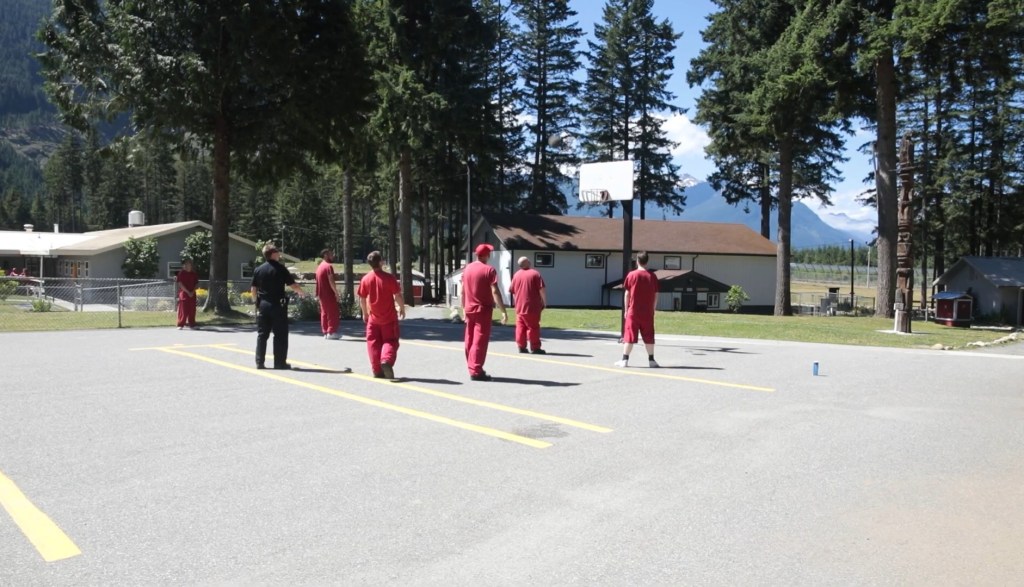
Parade square at Ford Mountain is in front of the administration building. (From left to right, the dinning hall, the gymnasium, the baseball field, and Alpha hut.) Photo courtesy of BC Public Service/YouTube.
Kevin and I also enjoyed walking this same dark path, and I told him the same story of how I got here. He disclosed to me that he’d also worked in the film and television industry. Now he was working in the computer science field, which was something I’d been interested in before being incarcerated. I’d actually been accepted into BCIT for their diploma program, but since I was stuck here, I’d have to put all that on pause.
There began to be some issues between me and some of the guys I lived with in Delta hut. They were of the typical prison variety, completely immersed the day-to-day life at Ford Mountain, who was who, who said what. I didn’t really have a problem with them, but for whatever reason, they decided they didn’t like me. So, they campaigned against me to have me removed from the hut.
At some point I was hired to work in the kitchen, which thrilled me, because that’s where Kevin worked. At least I’d be closer to a friend now, I figured. This bliss lasted the month, until the end of December, when one of the other residents working in the kitchen also decided he didn’t like me. I used the opportunity to quit that job and to move into Bravo hut, which was the ultimate goal, because that’s where Kevin, Jessie, and Adams lived.
Adams was a funny man, he was fairly well built, in his 30s, with a large beard. He was the hut leader for Bravo, as well as being on the RLC council. He was a former chef in a kitchen on the outside, and every Friday night at Chaplain’s Trivia he decimated everyone else. Perhaps he simply played a lot of Trivial Pursuit, or read a lot of books. He certainly gave me a run for my money!
The Chaplain decided to sweeten the pot, literally, and began bribing residents to come to trivia with the promise of chocolate. So, every Friday night dozens of people with no interest in trivia or knowledge of any kind would show up and yell out random non sequiturs and they’d receive a chocolate for it anyways. The winning team got two. The teams were split based on which side of the room one sat on
Around the holiday season, just before I was hired to work in the kitchen, Jessie and I were still on grounds together. We were assigned to set up Christmas trees around the camp, one for each hut, one in the dinning hall, one in Holloway House (where the Chaplain held church service every Sunday), and one in the school building. I used the opportunity to try to get to know Jessie more, and perhaps to try flirting.
The Chaplain had a piano keyboard in his office that he was allowed to lend me, but only on the condition that he was present and I returned it to him after using it. If you recall the infamous CTV video of me, they used a soundbite of me playing the piano quite horribly. To be fair to me, that is not the best video of my performance of that song. I decided that this was a sign from God, or the universe, that I should continue to keep learning the piano, so I took advantage of the time I had and the fact that there was a keyboard to practice with.
There was a school portable building on site as well, where a teacher from the Chilliwack school district worked full-time. Since I had been incarcerated, I was no longer able to attend any post secondary programs. However, I could use this time to upgrade so that I could apply to any post secondary program I wanted.
In journalism, we often made fun of ourselves, saying we’d only become journalists because we weren’t any good at math. For me, this was true, at least for most of my life. At Ford Mountain, I was taking Pre Calculus 12. For anybody good at math, this might seem like an easy semester, and for me it wasn’t terribly difficult either, but remember that this is prison. Most of the people I was surrounded by only had grade 10 workplace math. I gained a reputation really quickly for being some sort of genius, despite being fairly average at the math I was doing.
By the time I moved into Bravo hut, everything was going just fine for once. I was in a hut surrounded by friends who were more my kind of people, I was immersed in my studies, with a clear academic goal in sight, and I still believed there was a chance I could get parole and be back to the community in time to return to my studies there.
Bureaucracy
I had applied for parole in November, since I was told that it was best to apply early. The process can take several months, I was told. The process took much longer, and it is filled with inane bureaucracy. There are several things you might want to know about the parole process:
- Most cases are done by way of an in-office review (there is no “board”)
- Every time you submit a new document, the board can use that to push back having to respond even further
- Static and dynamic factors: these are your age, your marital situation, your employment, versus the offence type, treatment you’ve been in, etc. some of these factors weigh more than others in their decision, and often times these are the factors you have no control over
- Government bureaucracy is not designed to help offenders. If there are holes in the system which regular people fall through all the time, why should the government care about you as a criminal offender?
When I worked at CBC I could have probably contacted somebody at the Parole Board of Canada in the morning and have spoken to them by lunch over the phone, and gotten an interview before 2 pm. It was a simple email, I would say “Hi, my name is Vincent Papequash, I work for CBC News, we are doing a story on…” I did not see this same side of the government now that I was not working for them.
Over the next six months I waited patiently for the Parole Board to deny my application. That was the easy part. The hard part would be sending this to their Appeal Division, and to this day I have not heard back from them. I have since been released, so I do not imagine the Appeal Division will have anything meaningful to contribute, but a nominal victory would be to learn that some sort of error was made in processing my application back in 2025.
I spent most of last year hyper-focused on taking their decision to appeal. I wrote several reports of my own and submitted them to Ottawa. The Parole Board is not known for effective communication, or transparency. Recently, I had to submit an Access to Information and Privacy request just to view a document outlining their guiding policy when determining how to grant parole.
As a former government employee, myself (I’ve worked for Elections Canada, and Statistics Canada, as well as for the CBC, which is a Crown Corporation), I thought I was very bureaucratic. I tend to think very logically, in terms of policy and written documents and rules and regulations. One thing I took for granted was that the government recognizes itself, and it’s easy to accommodate somebody if you think they are one of your kind. As soon as you think you’re dealing with somebody on the outside, that’s when “policy” matters.
At some point in the spring of 2025 we learned at Ford Mountain that the Chilliwack school district was considering shutting down the school. I enjoyed working with the instructor at Ford Mountain, he’s a man I have great respect for. I also knew that the school program might be a way for a lot of residents to get out of working for a couple of hours in the day, but every once in a while somebody like me shows up and it’s more than a get-out-of-work-free card. It’s an opportunity to build a better future for one’s self.
I wrote to the Minister of Education, imploring her to find it in the budget, or to do something. Thankfully, others had also been advocating at various levels to ensure the school was not shut down. By the time the Minister sent my letter over to the head of BC Corrections for a response, they’d already agreed somewhere behind closed doors to allow the school to remain open. All was back in good order at Ford Mountain, for now.
This was how I spent most of 2025, writing reports to the Parole Board, and letters to the provincial government to try to impact policy at Ford Mountain. This was one part of my year, anyway, the business side. Often times I would spend my virtual visits scheduled with my mom and have her craft and send documents for me (she also worked for the government, previously, so she had some experience with it). It is strange that I spent so much time trying to deal with other government bureaucrats, and I often kept the very BC Corrections officers I was surrounded by at an arm’s length away.
This is unusual behaviour for inmates at Ford Mountain, most of them spent a considerable amount of time pestering or trying to befriend the guards. It’s a surreal environment, because there were days the staff would play pickleball with us, or go for walks with some of the residents. One officer actually got into some disciplinary trouble for being accused of having an inappropriate relationship with one of the residents, but lots of guys found her attractive, so perhaps it was all in their heads.
The truth was that I felt like it would be inappropriate to try to “befriend” any of the corrections staff. I don’t speak for all government employees, but when I was working in the government, I was often highly self-conscious about the optics and ethics of who I could and couldn’t associate with.
One day Jessie and I went to the gazebo to have a chat, and we were talking about our lives again. I was telling him about all of these feelings, and he hit the nail right on the head. He accused me of “living in a self-imposed golden cage.” I didn’t know how to have fun, or be human, or accept failure, or let go, and I was way too obsessed with my government work. He wasn’t the only one who suggested this, but I did appreciate his brutally honest comment.
Maybe this failure was a blessing in disguise, and coming to Ford Mountain was exactly what I needed. Time away from the city, and the appointments, and constantly having to be good at whatever I was doing, and obsessed with the optics of it all.
Catharsis
There are many programs of rehabilitation offered at Ford Mountain, as well as educational programs. As far as the official programs offered through BC Corrections:
- Anger management
- Substance abuse management
- Employment skills programs
- Various certificate programs (First Aid, some trades certificates, such as forklift training, or traffic control)
- Access to an onsite counselor
- FSOP (the forensic sex offender program)
And the residents also lead a few programs of their own, including:
- Alcoholics anonymous
- Sexaholics anonoymous
- Narcotics anonymous
There is access to the Indigenous Liaison office, staffed by three indigenous elders who come in at various times per week. They lead programs of their own, including:
- Arts and crafts
- Medicine Wheel
- Sweats and spirit baths
- Smudges
All around, Ford Mountain has access to numerous programs for all kinds of rehabilitation. One could never feel like there was never anything to do at Ford Mountain, since there was always something to do. These programs were merely what was offered during the day. The staff prioritized programs over work, so an inmate wouldn’t be criticized for opting to take as many programs as they needed.
On top of this, the residents, despite their petty squabbles (which were numerous) were very fraternal. People were friendly, and during the off-work hours (after 2 pm and well into the evening) people could be found in the gym, walking around together, or in the library playing board games or video games together.
I liked to joke around with Adams that I felt like I lived in the Young Money Mansion (a reference to a rap group). I was constantly surrounded by people, and generally I got along with people. Yes, there was drama from time to time, but overall I felt something I hadn’t felt in a long time. To put it another way, it was impossible to feel alone at Ford Mountain because I could literally never get alone time. I lived in a hut surrounded by 15 other guys and if I walked outside, there were three other huts with just as many people living in them. The staff were friendly, for the most part. Anywhere I turned, there were people.
It was cathartic, it was everything I was looking for. Maybe it wasn’t a cult from the 90s, we weren’t going to drink Kool Aid and ascend to heaven anytime soon. We did have that weird chant we did twice a week. And we all wore the same outfit. One of my biggest problems, the one that was the most detrimental to my mental health, was feeling alone. There I was, not alone.
I took many of the programs I listed above, and there are even more that I haven’t listed. Some of the best healing came from the friendships I’d made, though. Not in any structured program, but in the long walks with people, or the loud conversations in the library, and the constant joking around with people. I don’t think I’ve ever laughed more in my adult life. Prison is full of funny people.
This concludes Part II of this narrative.
All names of inmates and staff have been changed for privacy reasons. Names of organizations and public figures are unchanged. Although presented as a narrative, this is my account of true events. As a former journalist, I wanted to write about my experience after being incarcerated.
 Vincent Papequash