I went to prison, here is that experience: Part III

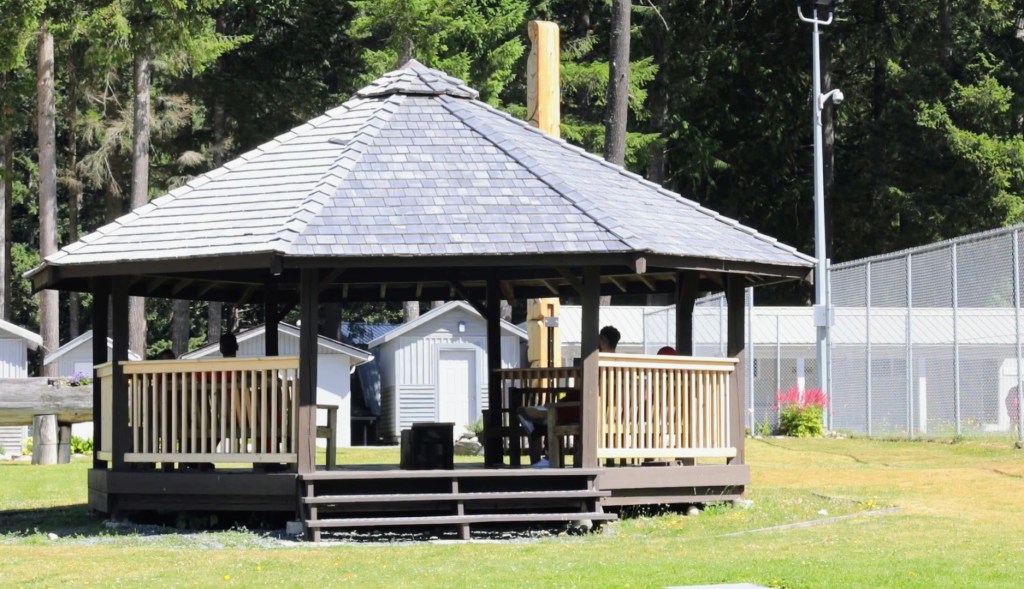
The gazebo at Ford Mountain. Photo courtesy of BC Public Service/YouTube
By the summer of 2025 I had basically given up on the idea of being released on day parole. I had sent their rejection to the Appeal Division, which is even less transparent than the Parole Board itself. I submitted a 15 page document outlining where I believed they went wrong. I applied for a program at a post-secondary institution for a September start date, and my last hope was that the Appeal Division would reverse the Board’s decision in time for me to start in the Fall semester.
Except, I was actually starting to like it here in this weird prison-cult I had been banished to in the mountains. In medieval Europe, when kings or queens were deposed, they were often sent to live in a monastery, or a convent. I felt like that is what happened to me, here.
Politics at Ford Mountain
Nestled in the mountains, Ford Mountain was certainly a scenic place to be banished to. I told the other residents I’d been friends with that if I wasn’t incarcerated here, I probably would have liked to stay anyway, for a bit. There was, however, a lot of politics amongst the residents that I refused to partake in.
- I went to prison — here is that experience: Part Four
- I went to prison — here is that experience: Part Three
- I went to prison — here is that experience: Part Two
- I went to prison — here is that experience: Part One
The only democratically elected positions in the camp were hut leaders, which were unpaid positions. They conducted the morning meetings from Tuesdays through to Thursdays (on Mondays and Fridays we had RLC assemblies in the gymnasium, where the whole camp was in attendance). Each week had a different theme, and the hut leader posed a question that all the residents living in that particular hut got an opportunity to answer. It was a coveted job for those who wanted power, but a despised one for those who actually had it, because the hut leader often had to mediate petty disputes between residents.
Then there was the RLC council, comprised of 3-5 residents who were appointed. These were paid positions, and they wielded real power. They conducted the Monday and Friday RLC meetings, appointed speakers for that week, hosted tournaments and movie nights, and had general power over other types of resident-led activities. I figured if I ever were to seek any position of power in this place, this is what I would aim for, but I never applied.
The truth was, I really didn’t want any kind of power in prison. Yes, it was a microcosm of society, but it wasn’t the same as being elected into public office. When I worked for CBC, I was very reverent about the little power that I had. I felt like a monk, or a priest in a church, that going into work was putting on a uniform and I only ever exercised power. I did not have power.
Jessie was different, however, and he wasn’t afraid to let anybody know. He made a lot of enemies quickly, because he started going around telling people about his charges rather openly. I will not disclose them, but he had no problem telling people. They are quite disturbing to mention, so I won’t, and I think that’s what pissed people off about him, was that he was so irreverent about it all. He showed no remorse, and often times he made people uncomfortable because he seemed to brag about it.
I’d told Jessie about my feelings for him, one night during a walk in the rain. He told me that he didn’t feel the same. Then he did something that pissed me off, and I was one of the few people who actually gave him a chance, even after he told everyone about his charges.
He really enjoyed playing the game Dungeons and Dragons, and he met another guy rather quickly named Marcus. I didn’t mind that Jessie was making other friends, but it was the way they behaved together that bothered me. Jessie was super close with Marcus, and affectionate, it felt like he was taking all of the efforts I was putting into him, ignoring it, and then turning around and giving all of that to Marcus.
It took a lot of conversations with other people for me to gain some perspective. Some people are not normal, they don’t respond to social cues the same way regular people do. If it is normal to treat your friends a certain way, some people do not behave in any of the appropriate ways. We call these people sociopaths. It begs the question, are some people really incapable of love?
Jessie had a troubled life, I came to learn through my conversations with him. He told me he had two children, but that his mother fought him in court to have them removed from his custody. His house burned down, and he believes his “friend” started it. Every story he ever told me was actually pretty sad. I am not saying he had an excuse to brag about his offence or to disturb other people, or to be a sociopath, but I do see how he might have ended up that way.
So, when Marcus was elected hut rep for Delta (back when I was living there at the end of 2024) I was not a happy camper. I figured that he and Jessie would use this new small amount of power to make me even more uncomfortable. Jessie asked me to play D&D with them, and I did. Except they were the worst kinds of people to play with. They made every game feel like they were on a personal date and everyone else was just a third wheel.
Jessie was a bit of a snob when it came to D&D. He invited people to play, and when they told him it was their first time, he said it was fine, but then he proceeded to bully them for asking too many questions, or for holding up the game. So, I quit after a month, because I didn’t want to hang out with somebody who couldn’t see how dense they were being.
After I moved into Bravo hut, I didn’t really talk to him anymore. I made new friends with his next door neighbours. One guy was named Erin, he used to work for the Canadian Armed Forces. The other guy was an Indigenous man from the Island, about my age, named Tyler. The three of us became really close, really fast. We went to the gym together, played board games together, but mostly we hung out in the hallway in front of their doors and drank coffee, and talked loudly. Jessie, Tyler, and Erin lived on the one side of the hut, and I was further down, so it must have annoyed Jessie that we were no longer speaking and I was still constantly outside his room with my new friends.
Eventually I decided to move right across the hall from them, I enjoyed their company so much. So, I put in my official request to the BC Corrections officer in charge of hut placements and waited a week. I was now also beside our current hut leader, Adams.
Adams, as I’ve said, was a chef on the outside. He was a burly kind of fellow, bordering on muscular. He had a beard but no hair. He was about my age, as well. I found him attractive enough, but it was also a personality thing. Sometimes people would walk around the hut shirtless, for example, after a shower (although, strictly speaking, this was against policy). Often, Adams would eye me up, and I’d be caught looking at him. We flirted regularly, although he was adamant that he was 100% straight. Later on he would joke that if he ever was gay for anybody, it was me.
All of this fun I was having was simply too much for Jessie, and midway through the summer he moved down the hall towards where I used to live. Although by then Erin and Tyler had been released. There was another man who moved into Tyler’s old room, named McAllister, who also, coincidentally, worked for the Canadian Armed Forces. Briefly, Erin was still there and the two of them bonded over that.
McAllister told me on day one that his father used to work for the BC NDP, and that he, himself, had a degree in political science. I thought that would make us friends, of course, but I underestimated the power of party lines, even in prison. He moved in at the end of February 2025, and the country was just about to head to the polls.
Inevitably, we argued over politics during the campaign season. By then Jessie already burned his bridge with McAllister (over bragging about his charges, of course). So, in that corner of the hut, McAllister and Jessie were feuding, and I didn’t like either of them, and all around it was pretty toxic. Then McAllister moved out of the hut one day, and I forgot where he went, but I didn’t speak to him again until the week before his release at the end of the summer.
Towards the end of the summer, it was finally Adams’ turn to leave. He’d done his time, and now he was moving on. He stepped down as hut rep for Bravo, and in the power vacuum that was left behind, Jessie Jacobs put his name forward and was elected, by some sort of dumb luck I guess. He wasn’t ideal, he was concerned solely with the power it brought him. Hut reps were supposed to be impartial, and unite the residents, but Jessie was the exact opposite of those things.
His reign of terror was short lived, and he too grew weary of the responsibilities of being hut rep. As Jessie put it, “I don’t get paid enough for this s***.” So, he stepped down, and by then we had a new resident who was nearly exactly like Adams was. His name was Justin, a 49-year-old man with a beard, who could play the guitar and had a magnetic personality.
Can’t Help Falling in Love
It was now the end of the summer, heading into September. I hadn’t heard anything from the Appeal Division, so I withdrew from the seat I’d been offered in the program I was accepted into. I resigned myself to my fate at Ford Mountain for the next six months.
One day in Indigenous arts and crafts (the program held on Tuesdays in the Native Liaison office by a former BC Corrections staff member, turned volunteer) I was finishing off a beading project I’d been working on. One of the residents asked me a rather typical question as far as prison small-talk went, and I reacted in a rather serendipitous way.
He asked me, “so how long do you have left before you’re released?” Recall the first rule I learned about prison: people in prison only seem to ever talk about being in prison, why they’re in prison, why you’re in prison, and other prisoners. I was honestly so fed up with it all, especially because at that time I was still tender about not receiving day parole in time to start school. I was mentally and emotionally checked out by then, and the last thing I wanted to do was have yet another conversation about prison with a fellow prisoner.
My response was “why do people in prison only ever talk about prison? Why isn’t the question ever, ‘what’s your favourite colour, Vincent?’ or ‘what do you like to do on the outside?’” I had several looks from people who were in the room, namely the lady who ran the program. She was a very cordial person, and she carried on the conversation gently. However, what I didn’t realize in that moment was I caught somebody else’s attention.
I’d already finished Pre Calculus 12 in March, I needed to so that I could apply to the program I wanted to start in September at the college I wanted to attend. So, that summer, with the hope of being released imminently, I started learning Calculus (note the absence of the prefix). The teacher at the school onsite, thankfully, had a college-level textbook available for me to use. If you ever get a chance, I highly recommend Calculus: Early Transcendentals by James Stewart.
That evening, in mid-September, I had been working on a particularly difficult problem. I think I was in chapter 5 or 6 at the time. Whenever I got stuck on a problem, I didn’t like to just pass over it and move on. I was in prison, I had all the time in the world, I figured. So, I would get up and go for a walk, and then come back to it. I would spend all day on the problem, or two days, if necessary. Well, I’d run into one of those problems again, and I was feeling particularly frustrated over it.
So, I got up and went for a walk around the baseball field behind Alpha hut and the gymnasium. We were in the dog days of summer, so it was still light out around 7 pm. As I was walking, fuming over the problem, a man walked up beside me and said hello.
His name was Matthew Strauss, he was about my age I figured, perhaps a little older. He had dark hair, and a beard, and was maybe my weight. He was caucasian, and spoke with a British accent. He’d actually arrived there about a month before, but we never spoke because we travelled in different circles. His friend was this macho, popular guy who was a bit obnoxious for me. I thought Matthew was good looking, but his friend was probably the more obvious type. Matthew seemed low key.
I said hello back, and we walked together for a bit. He said that he really enjoyed what I said today at arts and crafts. By then I’d completely forgotten it, but he reminded me. He said that he agreed, that people in prison tended to forget that we all had lives and things we liked to do. There were better things to talk about, and it really made him think. I accepted his compliment and asked him what his favourite colour was. Blue. A good start, as that was mine, too.
He and I parted ways after a couple of laps together, and that was that for the evening. I went back to my calculus problem and solved it. I don’t remember what it was. I think it could have been an approximation problem I was overthinking, or maybe Newton’s method and I just wasn’t computing hard enough. My walk with Matthew really helped clear my head.
The next evening we found each other on the track around the baseball field again and joined up. We walked and talked more thoroughly. We talked about our former jobs, and lives. I told him all about my time at CBC, since I figured that’s all anybody would be interested in. He didn’t seem to mind listening to my winding story about how I ended up here. He told me about some of the work he did, and living on the Island.
Matthew was from the United Kingdom, which wasn’t surprising, given his accent. He wasn’t like the others, either, because he didn’t like to talk about what led him to prison, per se. He seemed to have had a full life outside of all of this, and there in the field, just the two of us, it felt like he didn’t care a lot about the drama around here.
He came into my life exactly when I needed him to. Like a knight in shining armour, just as the last rays of hope died out and I settled into my fate. Maybe it was just the last rays of the summer sun, though, I was sensing. All I knew in that moment, walking with him in the field, was that it felt right. He made me feel calm in a situation where I was realizing I had no control.
This concludes Part III of this narrative.
All names of inmates and staff have been changed for privacy reasons. Names of organizations and public figures are unchanged. Although presented as a narrative, this is my account of true events. As a former journalist, I wanted to write about my experience after being incarcerated.
 Vincent Papequash